

Updated: November 2026
4 min read
Choosing Flowers for Every Occasion in Romania
Which flowers suit birthdays, name days, anniversaries, a new baby, thanks, illness, 1 and 8 March, graduations or condolences, with Romanian customs.
Flower guide

The meaning of a flower is not written down anywhere. It forms over time, out of customs, holidays and what people saw in their grandparents' homes. What follows are Romanian folk traditions and beliefs, told as such. They vary from region to region and from family to family, and a bouquet chosen with care matters more than any dictionary of flowers.
On 1 March, Romanians give the mărțișor, a small object tied to a cord twisted from two threads, one white and one red. Tradition says that whoever wears it receives health and luck for the coming year. It is pinned to the chest or tied around the wrist. Many wear it for a few days, then tie it to a blossoming tree, which is where the custom of tying the mărțișor to a tree comes from.
The flowers that go with the mărțișor are the earliest ones: snowdrops, then hyacinths, tulips and squills (viorele). The snowdrop is the flower that announces spring, and in folklore it is tied to the end of winter. Wild snowdrops are a protected species, so buy cultivated snowdrops, not ones picked from the wild. On 8 March, flowers are given to the women in our lives. Tulips, hyacinths and freesias are among the most common.
Florii (Palm Sunday) is celebrated a week before Easter and recalls Jesus' entry into Jerusalem, welcomed with palm branches. In Romania, willow branches blessed at church are used in place of palms. On Florii, people with flower-related names celebrate their name day, such as Florin, Florina, Floarea, Florica, Viorel, Viorica. It is the classic occasion to give a bouquet or a flowering plant. Because it is tied to Easter, the date changes from year to year.
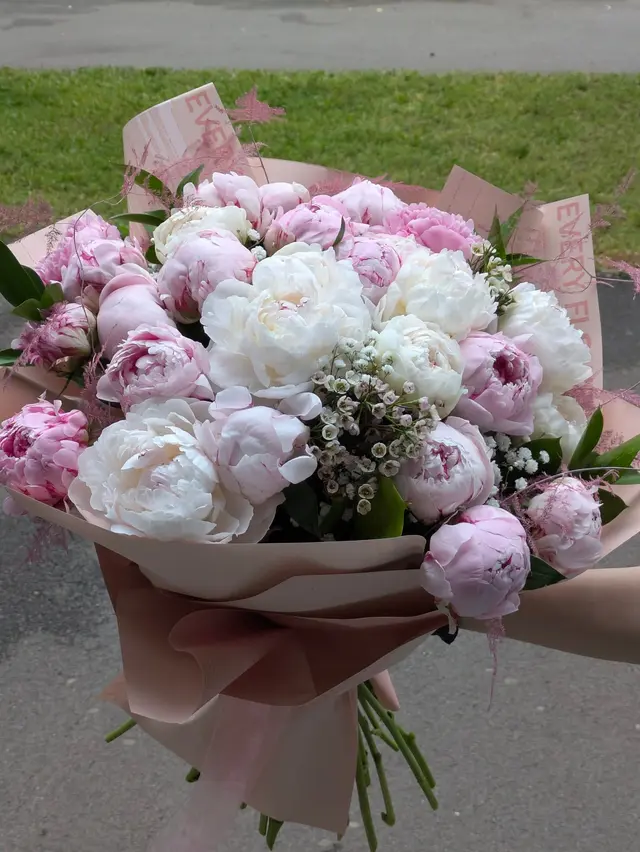
The peony blooms at the end of spring, in May and June, and remains one of the best-loved garden flowers. It has full petals and a discreet scent, and in many cultures it is seen as a symbol of abundance and joy. The Romanian peony (Paeonia peregrina) is a protected species and must not be picked in the wild. Cultivated peonies are only available for a few weeks a year, which is why peony bouquets are discussed well in advance, especially for weddings.
Carnations are hardy and easy to grow, which is why they were for a long time the everyday flowers of celebrations in Romania. They are given on 8 March, at the end of the school year and in many homes on holidays. At the same time, carnations are also laid at monuments and graves, at commemorations, which gives them a second meaning. That is why colour and occasion matter: a cheerful mixed bouquet will not be mistaken for a mourning one, but an even number of red carnations leaves room for interpretation.
In Christian tradition, the white lily (the Madonna lily, Lilium candidum) symbolises purity and is associated with the Virgin Mary. That is why you find it at baptisms, weddings and religious feasts, but also in funeral arrangements. Lilies have a strong scent, so think about where you put them. They are also poisonous to cats.
In the everyday language of flowers, the most common associations are these. Red: love and passion. White: purity, beginnings, but also mourning, depending on the occasion. Pink: tenderness and gratitude. Yellow: joy and friendship. Orange: energy. Purple: elegance. These are not rules. The same flower may mean something else in another town or to other people, and many people simply choose the colour the recipient likes.
White and coloured chrysanthemums are placed on graves around 1 November and at memorial services. For this reason many Romanians associate them with mourning and avoid giving them on birthdays. For a cheerful occasion, it is better to choose something else. For what suits each occasion, see the guide which flowers to choose for each occasion.
Traditions give us reference points, not strict rules. If you want to respect the custom, choose seasonal flowers, an odd number for the living, and avoid chrysanthemums at celebrations. If you want a bouquet for a particular occasion, seasonal flowers in Romania are a good starting point. For particular flowers, the online shop has dedicated pages: tulip bouquets, carnation bouquets and lily bouquets.

